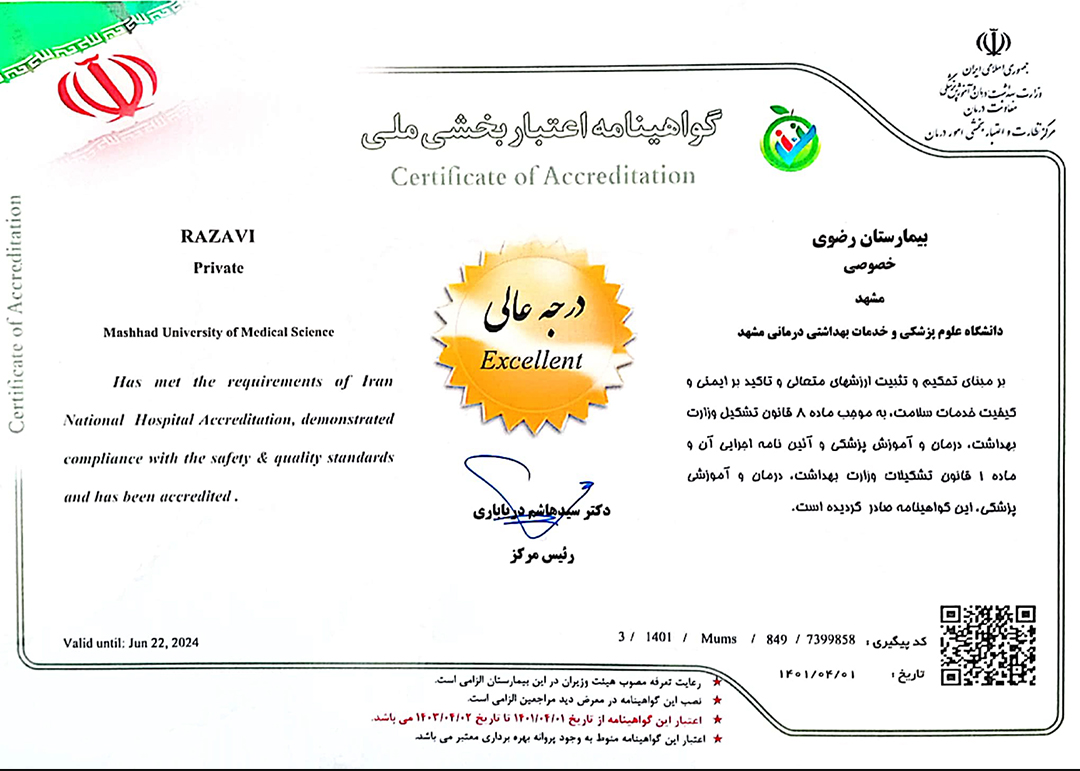
This unit began its activities at Razavi Hospital in late Khordad 1389 (June 2010), in accordance with the directive of the Deputy for Treatment of Mashhad University of Medical Sciences. It is currently located on the second floor of Phase 2 and operates under the direct supervision of the Hospital’s CEO.
All efforts at Razavi Hospital are focused on achieving the highest level of national accreditation (Excellent Grade One), in honor of the hospital’s affiliation with the illuminated shrine of Imam Reza (AS). The core of the continuous, round‑the‑clock efforts of the hospital’s managers and staff toward this noble goal is the enhancement of the quality of services provided to patients and clients.
Within this strategic framework, fundamental measures aligned with the hospital’s vision, mission, and macro‑level objectives have been planned and implemented. The hospital’s approach and focus emphasize patient safety, continuous quality improvement, and health promotion.
Our commitment at this hospital is to provide the highest level of therapeutic care and services that exceed patient expectations.
The Quality Improvement Unit is the beating heart of this commitment. By utilizing robust data, teamwork, and deep respect for our patients, this unit continuously strives to enhance clinical standards, patient safety, and the overall patient experience.
We believe that quality is not a destination, but an ongoing journey of learning, evaluation, and innovation.
Currently, national accreditation standards aimed at improving service quality and patient safety—aligned with the objectives of the Ministry of Health—are being implemented in this unit. In addition, the following quality‑related standards have been adopted and implemented to enhance organizational performance:
- International Accreditation Standards
- National Accreditation Standards – Excellent Grade
- Integrated Management System (IMS):
- ISO 9001
- ISO 18001
- ISO 14000
- Training Management Standard: ISO 10015
- Energy Management Standard: ISO 50001
- Information Security Management Standard: ISO 27000
- Food Safety and Nutrition Standards: ISO 22000 and HACCP
These international accreditation standards have been implemented to promote organizational quality.
Document Control and Process Improvement
- Coding all hospital documents in accordance with document coding guidelines
- Supervising document review, distribution, and collection of obsolete or outdated documents in line with document control procedures
- Designing hospital processes based on quality improvement principles
- Monitoring organizational processes and proposing improvements to enhance performance
- Developing policies, procedures, and work instructions for hospital departments and units in collaboration with relevant managers and supervisors
- Establishing a system for reporting medical and non‑medical errors in cooperation with the Occupational Safety and Health Unit
- Collaborating with administrative experts on performance evaluation and job description development
Internal Audit
In another key role, the Quality Improvement Unit oversees and organizes the correct implementation of standards through internal audits at Razavi Hospital. Scheduled internal inspections are planned by this unit, and regular reports of inspections and internal evaluations are prepared to identify opportunities for improvement and communicated to relevant managers. Through this process, comprehensive oversight of hospital accreditation activities is ensured.
Internal audit activities include:
- Systematic planning of internal hospital inspections
- Participation in internal audits in line with implemented standards
- Preparation of audit reports and follow‑up of corrective actions
- Compilation of regular reports from inspections and internal evaluations
- Utilization of collective wisdom and shared expertise
Collective Wisdom and Leadership
Effective management requires a comprehensive and scientific perspective on various issues. A key factor in managerial success is avoiding unilateral decision‑making and instead basing decisions on collective wisdom and consultation. Sound and effective decisions are achieved through collaboration and shared insight.
The presence of former and current presidents of Mashhad University of Medical Sciences, along with distinguished members of the national medical community, at the Scientific Council meetings of this institution has significantly enriched its academic capacity.
Management and leadership meetings at Razavi Hospital are held continuously and without interruption, in accordance with the meeting calendar, accreditation standards, and defined responsibilities, with the participation of all senior managers and executive unit heads. Following discussion and exchange of views on operational matters, collective decisions are made.
Conclusion: An Endless Journey Toward Excellence
At Razavi Hospital, we do not view quality improvement as a project with a defined end date. Rather, we consider it a permanent organizational commitment that must be institutionalized in every activity and embraced by all hospital staff.
Head of Quality Improvement Unit:
Mahsa Abrishami
Education: Master’s Degree in Management
Role: Follow‑up and Coordination
Patient Affairs Officer:
Masoumeh Habibi
Education: Bachelor’s Degree in Nursing